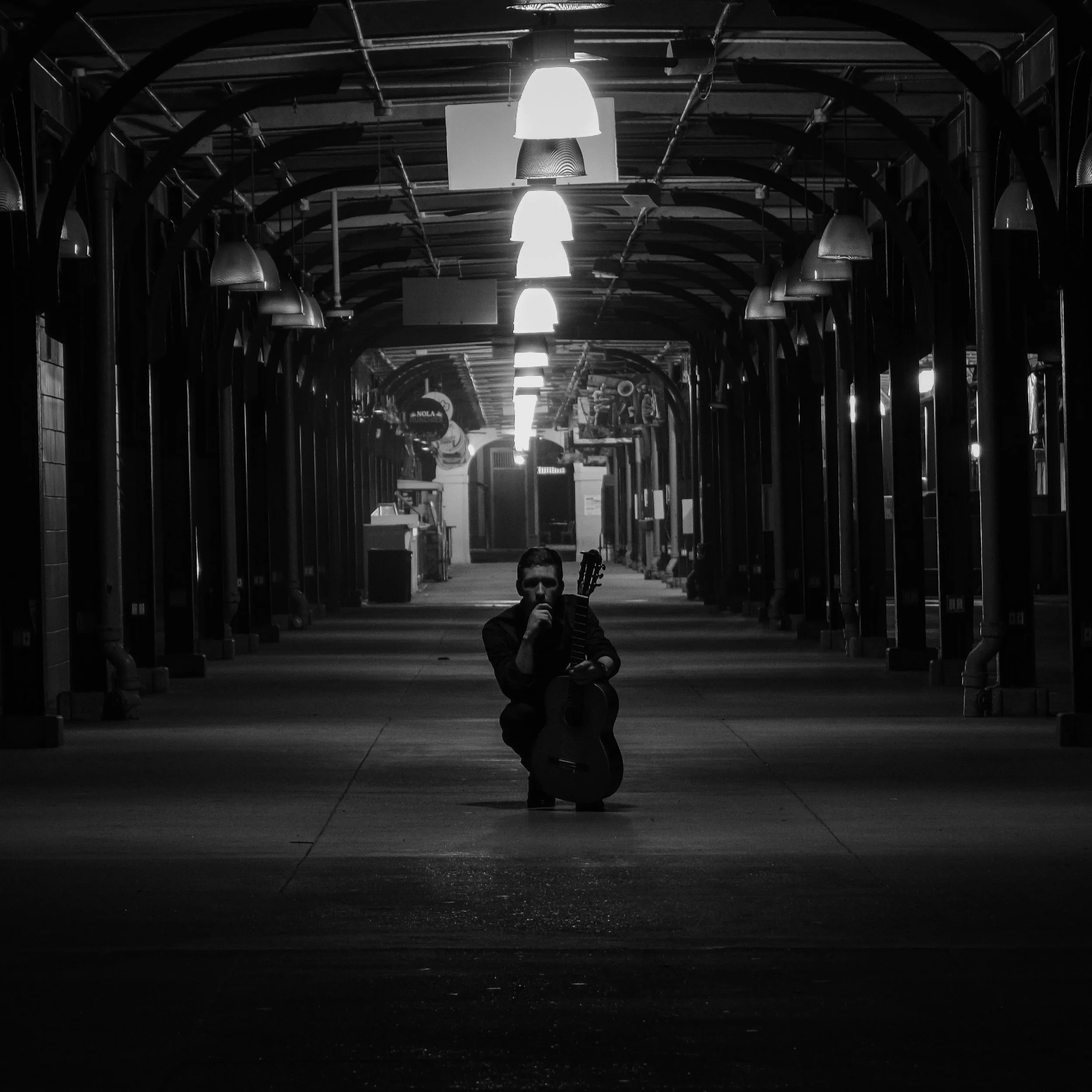
RECITAL PROGRAM
Taylor Scott Counce
Classical Guitarist and Composer
Program
Cuatro Valses Venezolanos
Antonio Lauro (1917–1986)
I. “Tatiana”
II. “Andreína”
III. “Natalia”
IV. “Yacambú”
II. “Andreína”
III. “Natalia”
IV. “Yacambú”
Dedicatoria, from Cuentos de la juventud, Op. 1
Enrique Granados (1867–1916), transcribed by Miguel Llobet (1878–1938)
Valseana, from Aquarelle
Sérgio Assad (b. 1952)
The Rose in the Garden
Carlo Domeniconi (b. 1947)
The Old Lime Tree (Lipa Vekovaya)
Russian folk song, arranged by Sergei Rudnev (b. 1955)
Big Blue Sky
Taylor Scott Counce (b. 1997)
Fifollet (feu follet)
Taylor Scott Counce (b. 1997)
Southern Nights (for Solo Guitar)
Allen Toussaint, arranged by Taylor Scott Counce (b. 1997)
Just a Closer Walk with Thee
African American traditional, arranged by Taylor Scott Counce (b. 1997)
Program Notes
Vals Venezolanos Nos. 1–4 — Antonio Lauro
Antonio Lauro (1917–1986) is widely considered the father of the Venezuelan classical guitar. His Cuatro Valses Venezolanos were composed while touring abroad, yet they feel deeply rooted — wistful and lyrical in a way that belongs entirely to Venezuelan popular song. Three of the four bear the names of women in his life: his nieces Tatiana and Andreína and his daughter Natalia. The fourth, Yacambú, takes its name from the mountains of western Venezuela. Together they form a portrait as personal as it is musical.
Dedicatoria, from Cuentos de la juventud — Granados, trans. Llobet
Enrique Granados wrote Cuentos de la juventud as a set of character pieces evoking the feeling of youth — tender, unhurried, and intimate. The opening Dedicatoria, a quiet offering in D major, was transcribed for guitar by the Spanish guitarist and Tárrega pupil Miguel Llobet, who was among Granados' closest artistic collaborators. It leads without pause into Assad's Valseana — a Brazilian waltz that begins in the same harmonic warmth before finding its own voice.
Valseana, from Aquarelle — Sérgio Assad
Sérgio Assad's Aquarelle — French for watercolor — takes its name from his wife's passion for the medium, its blended hues and translucent layers suggesting how the suite's notes are conceived to ring into one another. Valseana is its Brazilian waltz, deceptively light on the surface but harmonically restless beneath it, built around a cadence that keeps slipping away just before it resolves. It arrives here without pause from Granados' Dedicatoria, the waltz form threading the two composers together across a century of distance.
The Rose in the Garden — Carlo Domeniconi
Carlo Domeniconi is an Italian composer and guitarist whose music moves freely between European classical tradition and the folk languages of the Mediterranean and Middle East. The Rose in the Garden has been a long-standing piece in my repertoire — meditative in character, searching in its harmony. It opens a section of the program that turns quietly toward nature, a tonal garden that deepens through the Russian folk landscape of The Old Lime Tree before arriving at Big Blue Sky.
The Old Lime Tree (Lipa Vekovaya) — Sergei Rudnev
Lipa Vekovaya — The Old Lime Tree — is a Russian folk song of love, loss and longing, arranged here by guitarist and composer Sergei Rudnev. It appears on my most recent album, and has become one of the most personally significant pieces in my repertoire. For me it evokes a specific memory: the japonica plum tree in my grandparents' backyard, the particular quality of light and stillness that lives in that place.
Big Blue Sky — Taylor Scott Counce
Big Blue Sky was born from a road trip west during my undergraduate years — through the foothills of Arkansas, the flatlands of Oklahoma and Kansas, and into the sudden, awe-inspiring unfolding of the Rocky Mountains. It is a piece about smallness in a grand world and the feeling of leaving home. The tremolo melody carries that sense of vastness — something just out of reach, stretching toward a horizon that keeps expanding. It is dedicated to my grandmother.
Fifollet (feu follet) — Taylor Scott Counce
Feu follet — literally "foolish fire" in French — is among the most enduring figures in Louisiana's Cajun and Creole folklore. The flickering lights seen above the swamps were explained by Catholic tradition as the souls of unbaptized children, unable to enter heaven and relegated to an eternal limbo on earth. They wander, playful and mischievous, leading travelers astray in the marsh — or, in some tellings, toward hidden treasure. The Louisiana fifollet carries the blended weight of French, African and Caribbean tradition, its name and nature shaped by centuries of cultures converging in the same landscape. Written in open G minor tuning, the piece traces that same arc — a theme that rises toward something like wistful jubilee before dissolving back into tonal ambiguity, never quite arriving, never quite lost.
Southern Nights (for Solo Guitar) — Allen Toussaint, arr. Taylor Scott Counce
Allen Toussaint (1938–2015) is one of the great figures of New Orleans music — songwriter, producer and pianist whose fingerprints are on decades of Louisiana rhythm and blues. Southern Nights was the last song written for his 1975 album of the same name. Producer Van Dyke Parks posed a question to Toussaint in the studio: "Consider that you were going to die in two weeks. If you knew that, what would you think you would like to have done?” – Toussaint wrote the song as soon as Parks left. It came from memories of childhood visits to Creole family in rural Louisiana — porch storytelling, star-filled skies, the feeling of a place that lives more in memory than in the moment. This arrangement is an hommage to that original vision — impressionistic in the spirit of Toussaint's own playing — and to a New Orleans legend.
Just a Closer Walk with Thee — African American traditional, arr. Taylor Scott Counce
Just a Closer Walk with Thee is one of the most beloved hymns in the New Orleans tradition — a funeral procession standard, a Sunday morning standard, a song that belongs to the city. This setting borrows its rhythmic foundation from Agustín Barrios Mangoré's Una Limosna por el Amor de Dios — his final composition, written after hearing an elderly woman knock at his door asking for alms. That knocking pulse, persistent and gentle beneath the tremolo melody, carries the hymn forward here as it did for Barrios: a quiet pleading, an act of faith, a hand extended in the dark.
Livestream-friendly edition of the recital program